Wallfacer smile
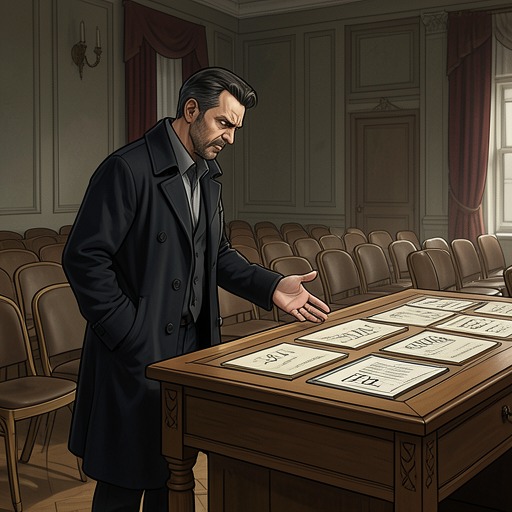
The Dark ForestThe Wallfacer smile is the characteristic expression through which the Wallfacer Project makes uncertainty visible. It is at once a sign of confidence, a mask that conceals ignorance, and a social mechanism that transforms every action by a Wallfacer into a possible move in an unseen plan. Its power lies not in communicating a definite message, but in refusing to settle whether any message exists at all.
Origin and Meaning
The expression is first given its decisive meaning when Say stands beside the United Nations flag and answers Luo Ji’s anxious question about whether he is still a Wallfacer with a slight, familiar smile rather than a direct explanation. Luo Ji recognizes that he has seen the same smile on the face of the young assailant who attacked him. In that instant, the gesture becomes more than an individual reaction: it is a shared sign used by people who understand that the Wallfacer status cannot be judged from outward behavior.
Luo Ji realizes that the smile asks a question no observer can answer: how can anyone know whether a Wallfacer has already begun work? The project’s logic prevents its chosen agents from being consulted before appointment and prevents them from simply refusing or abandoning the mission afterward. Once the identity and task are assigned, an invisible barrier separates the Wallfacer from ordinary people, because even an apparently meaningless action may conceal strategic significance. The smile therefore expresses not knowledge of the Wallfacer’s plan, but the impossibility of proving that no plan exists.
The gesture calms Luo Ji because it allows him to understand the true nature of his position. He is not released from the project merely because his actions look idle, confused, or personal. Instead, every action will be greeted with the same ambiguous expression and invested with the significance of the Wallfacer Project. The smile offers reassurance while simultaneously confirming that the curse of the role cannot be escaped through explanation.
A Social Technology of Secrecy
The smile belongs to a wider economy of concealment. In his advice to Luo Ji, Shi Qiang explains that genuine shrewdness must not look like shrewdness. A strategically intelligent person should avoid appearing important, threatening, or even particularly intelligent; appearing careless, unserious, or beneath notice can prevent others from treating that person as an obstacle. The ideal is to become so inconspicuous that others fail to notice the danger until the instant before it reaches them.
This principle clarifies why the Wallfacer smile is so effective. It does not expose a secret strategy, but it makes concealment itself socially contagious. Once people know that a Wallfacer is expected to think privately and act publicly under conditions of radical uncertainty, they can no longer distinguish genuine preparation from distraction, failure from deception, or personal behavior from strategic performance. The expression becomes a kind of public mask placed over an unknowable interior.
The smile also reflects the contrast between human strategic culture and Trisolaran communication. The Trisolarans find the human ideas of cheating and lying difficult to understand because their face-to-face communication makes thought transparent and prevents deception. Human politics, by contrast, depends on scheming, pretending, and withholding intention. The Wallfacer smile condenses that human capacity for hidden thought into a single visible gesture: the outside world sees the expression, but cannot read the mind behind it.
The Idiom and Its Repetition
The expression soon becomes famous enough to enter public language. It is compared with the smile of the Mona Lisa and the grin of the Cheshire cat, both of which suggest an unreadable relation between appearance and meaning. Yet the Wallfacer smile is more than a literary comparison. It becomes a recurring response directed at Wallfacers by institutions, officials, and crowds, each time restoring the same uncertainty about what the subject is truly doing.
The Wallfacer Project produces a related idiom when Luo Ji orders the purchase of an astonishingly expensive cask whose price begins at three hundred thousand euros. He insists that the purchase is part of his plan, even though its purpose appears absurd to those around him. From then on, anything clearly unreasonable but nevertheless required to be done can be dismissed as “part of the plan.” The two expressions work together: the smile marks the observer’s uncertainty about hidden intention, while the idiom supplies a ready-made justification for seemingly irrational conduct.
Both expressions reveal how the project changes ordinary language. A smile no longer means simple friendliness or amusement, and a plan no longer has to be visible, coherent, or explainable. Under the pressure of the Wallfacer role, social interpretation becomes an exercise in strategic suspicion.
Tyler and the Vicious Cycle
Frederick Tyler experiences the smile as a form of psychological imprisonment. At a hearing, he declares that the Wallbreaker’s analysis is correct and admits that his strategy is the mosquito swarm. He asks to be tried under national and international law, but the PDC’s rotating chair and permanent-member representatives merely look at him with the Wallfacer smile before adjourning the meeting.
Tyler then breaks down, flees into the square, and publicly announces that he is Frederick Tyler, that his Wallbreaker has exposed his strategy, and that he is going to attack the Earth fleet with the mosquito swarm. He calls himself anti-human, a devil, and someone who should be punished and killed. The outburst is an attempt to force an ordinary interpretation onto a situation in which no statement can be accepted as final. Yet the crowd’s reactions only deepen his despair: their eyes treat him as a Wallfacer who must be secretly working on an immense strategy capable of saving the world.
When Luo Ji answers Tyler’s anger with a silent smile, Tyler recognizes the gesture immediately. His own thin smile becomes hysterical laughter as he accuses Luo Ji of giving him the Wallfacer smile from one Wallfacer to another, of assuming that Tyler is performing a role and will save humanity. The scene exposes the expression’s cruelty. Even an apparent confession is absorbed into the mythology of the project, and even a desperate denial becomes possible evidence of deeper deception. Luo Ji calls this a vicious cycle from which they will never be free; the smile is the visible form of that cycle, because it keeps interpretation alive after certainty has collapsed.
Institutional and Existential Significance
The Wallfacer smile survives because the conditions that created it spread beyond individual encounters. It is not confined to Say’s office or to Luo Ji’s dealings with officials. It becomes a convention through which humanity responds to hidden plans, impossible responsibilities, and the fear that an apparently inactive person may already be acting. The expression converts uncertainty into a collective posture.
Its deepest significance is therefore political and psychological at once. Politically, it protects the secrecy on which the Wallfacer Project depends, since no observer can safely conclude that a Wallfacer is inactive. Psychologically, it places the Wallfacer inside a hall of mirrors: every gesture is watched, every denial is interpreted, and every attempt to appear ordinary may be recognized as a sophisticated performance. The face remains visible while the mind becomes inaccessible.
The smile also carries a paradoxical hope. It appears in a world where human beings confront an enemy whose transparent thought makes ordinary human deception difficult to imagine, yet it becomes proof that secrecy, ambiguity, and strategic imagination remain human resources. Its reassurance is never innocent. To smile at a Wallfacer is to acknowledge that humanity cannot know what is happening, but must continue acting as though the hidden work may still matter. In that sense, the Wallfacer smile is both the emblem of the project’s burden and the social ritual by which that burden is endured.